Steal This Job Search Cheat Sheet: 75 Websites + AI to Find the Right Career
Stop applying to hundreds of jobs. Start making smarter career decisions with AI.
Looking for a job can feel overwhelming. You browse LinkedIn, update your resume, apply to dozens of positions, and wait for responses that may never arrive.
But what if the problem isn’t the number of jobs you’re applying for? What if you haven’t identified the right role for your skills in the first place?
At Ovi Design Academy, we believe a successful career starts with understanding the market, identifying your strengths, and building skills that employers actually need.
Here is a practical strategy to transform your job search using 75 useful websites, AI tools, and a structured decision-making process.
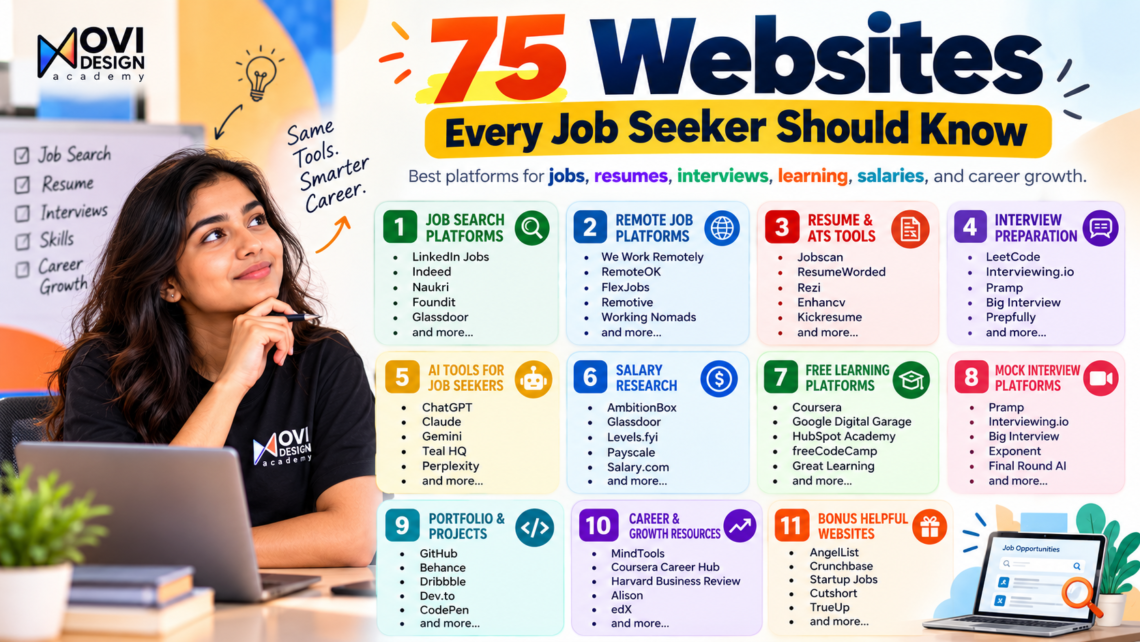
1. Explore the Right Websites for Your Job Search
Don’t use every website just to submit applications. Use each platform for a specific purpose.
Job search platforms
Start by understanding which companies are hiring and what skills they expect.
- LinkedIn Jobs — linkedin.com/jobs
- Indeed — indeed.com
- Naukri — naukri.com
- Foundit — foundit.in
- Glassdoor — glassdoor.com
- Wellfound — wellfound.com
- Freshersworld — freshersworld.com
- TimesJobs — timesjobs.com
- Internshala — internshala.com
- Hirist — hirist.com
Remote job platforms
Explore remote opportunities and discover which companies offer flexible working arrangements.
- We Work Remotely — weworkremotely.com
- Remote OK — remoteok.io
- FlexJobs — flexjobs.com
- Remotive — remotive.com
- Working Nomads — workingnomads.com
- Dynamite Jobs — dynamitejobs.com
- JustRemote — justremote.co
- Jobspresso — jobspresso.co
- Himalayas — himalayas.app
- Remote.co — remote.co
Resume and ATS tools
Learn how applicant tracking systems evaluate resumes and compare your experience with job requirements.
- Jobscan — jobscan.co
- Resume Worded — resumeworded.com
- Rezi — rezi.ai
- Enhancv — enhancv.com
- Kickresume — kickresume.com
Interview preparation
Practice answering common questions and prepare examples that demonstrate your skills.
- LeetCode — leetcode.com
- Interviewing.io — interviewing.io
- Pramp — pramp.com
- Exponent — tryexponent.com
- Big Interview — biginterview.com
- Glassdoor — glassdoor.com
- Prepfully — prepfully.com
- Yoodli — yoodli.ai
- GeeksforGeeks — geeksforgeeks.org
- HackerRank — hackerrank.com
AI tools for job seekers
Use AI to research career paths, organize information, improve your resume, and prepare for interviews.
- ChatGPT — chatgpt.com
- Claude — claude.ai
- Gemini — gemini.google.com
- Teal — tealhq.com
- Perplexity — perplexity.ai
Salary research
Research compensation before deciding which career path to pursue or negotiating an offer.
- AmbitionBox — ambitionbox.com
- Glassdoor Salaries — glassdoor.com/Salaries
- Levels.fyi — levels.fyi
- Payscale — payscale.com
- Salary.com — salary.com
Free learning platforms
Identify skill gaps and learn the fundamentals before investing in expensive training.
- Coursera — coursera.org
- Google Digital Garage — learndigitalwithgoogle.com
- HubSpot Academy — academy.hubspot.com
- freeCodeCamp — freecodecamp.org
- Great Learning — greatlearning.in
Mock interview platforms
Practice your responses, improve your communication, and build confidence before real interviews.
- Pramp — pramp.com
- Interviewing.io — interviewing.io
- Big Interview — biginterview.com
- Exponent — tryexponent.com
- Final Round AI — finalroundai.com
Portfolio and project platforms
Research how professionals present their work and create evidence of your own abilities.
- GitHub — github.com
- Behance — behance.net
- Dribbble — dribbble.com
- Dev.to — dev.to
- CodePen — codepen.io
Career growth resources
Explore learning opportunities, business knowledge, and resources for long-term professional development.
- MindTools — mindtools.com
- Coursera Career Hub — coursera.org/career
- Harvard Business Review — hbr.org
- Alison — alison.com
- edX — edx.org
Bonus websites for opportunities and research
- AngelList — angel.co
- Crunchbase — crunchbase.com
- Startup Jobs — startup.jobs
- Cutshort — cutshort.io
- TrueUp — trueup.io
- Jobaaj — jobaaj.com
- Jobicy — jobicy.com
- EU Careers — eu-careers.europa.eu
- UN Careers — careers.un.org
- USAJOBS — usajobs.gov
Note: Website availability, names, and services can change. Verify the current platform and the relevance of individual opportunities before using them.
2. Don’t Search for Every Job. Pick Three Career Paths.
Here is where most job seekers make a mistake: they apply for different roles without understanding what each role requires.
Instead, choose three roles that genuinely interest you.
For example:
- Customer Success Specialist — helping customers achieve their goals with a product or service.
- Product Operations Specialist — improving the processes, tools, and collaboration behind product teams.
- AI Automation Specialist — using AI tools and automation workflows to solve business problems.
Your choices will depend on your existing skills, interests, experience, and career goals.
3. Collect Evidence for Each Career Path
For each of your three selected roles, collect:
- 15 live job listings
- 3 salary ranges from relevant sources
- 5 strong portfolios or examples of relevant work
- 10 common interview questions
This gives you real-world information to evaluate each career path.
Use job boards to understand demand. Use salary websites to research compensation. Use portfolio platforms to examine the quality of work employers value. Use interview resources to identify frequently tested skills.
Your goal is not to collect more information. It is to make a better decision using evidence.
4. Use NotebookLM to Compare Your Research
Once you have collected job descriptions, salary information, portfolio examples, and interview questions, organize your research in NotebookLM.
Upload or add the relevant source documents, then use this prompt:
Prompt for NotebookLM
“Compare these three career paths using only the sources I have provided.
Evaluate each role based on:
- Job demand and hiring trends
- Salary potential
- Remote work opportunities
- Alignment with my current skills
- Difficulty of entering the role
Create a comparison table, cite the supporting sources for every assessment, and clearly identify where information is missing or insufficient.
Do not invent statistics or make unsupported claims.”
NotebookLM can help you synthesize your collected research and trace findings back to your sources. The quality of your conclusions depends on the quality and relevance of the information you provide.
5. Build a Career Scorecard with ChatGPT
Next, bring your research findings into ChatGPT and create a scorecard to compare the three roles.
Use this weighted model:
| Evaluation criteria | Weight |
|---|---|
| Job demand | 30% |
| Skill fit | 25% |
| Salary potential | 20% |
| Remote opportunities | 15% |
| Ability to demonstrate skills quickly | 10% |
| Total | 100% |
Ask ChatGPT to score each career path from 1 to 10 using your collected evidence, explain each score, and calculate the weighted total.
A higher score can help you identify the strongest option based on your priorities. It is a decision aid, not a guarantee of employment or future salary.
6. Open Claude and Build One Small Project
Now comes the most important step.
Research alone will not make you job-ready. You need to demonstrate that you can apply what you have learned.
Choose the strongest career path from your scorecard and ask Claude to help you plan one small project that demonstrates its three most important skills.
For example, if you choose UX/UI design, your project could include:
- Identifying a real user problem
- Conducting AI-assisted research
- Designing a user flow and interface
- Creating a functional prototype
- Testing the experience and documenting your decisions
If you choose AI automation, you might build a workflow that automates a repetitive business task and demonstrate its results.
If you choose Product Operations, you might create a product feedback analysis, a prioritization framework, or a process improvement proposal.
The objective is simple: build something that proves your skills instead of merely listing them on your resume.
7. Turn Your Project into Career Proof
Once your project is complete, document it clearly.
Include the problem, your approach, the tools you used, the decisions you made, the final outcome, and what you learned.
Publish the work in a relevant portfolio or repository, depending on your career path.
Then use that evidence to improve your resume, prepare for interviews, and explain why you are a strong candidate for the role.
Employers may still consider qualifications, experience, communication, and other factors, but a relevant project gives them something concrete to evaluate.
The Complete AI-Powered Job Search Workflow
Research → Compare → Score → Choose → Build → Showcase → Apply
Instead of spending weeks applying randomly, use this process to understand the market, identify the right opportunity, and develop evidence of your capabilities.
You don’t need to use all 75 websites. Start with the few that answer your most important questions, then expand your research when necessary.
Final Thought
The job market rewards more than the number of applications you submit.
It rewards relevant skills, clear communication, thoughtful problem-solving, and evidence that you can contribute to a team.
At Ovi Design Academy, we encourage aspiring designers and professionals to combine design thinking, AI tools, practical projects, and continuous learning to prepare for evolving careers.
Don’t just search for a job. Build the skills and proof that make you a stronger candidate.
Ready to build your next career skill?
Explore Ovi Design Academy and take the next step in your design journey.
Website: https://ovidesign.in/
Suggested SEO title: 75 Job Search Websites and AI Tools to Find the Right Career
Suggested meta description: Discover useful job search websites, salary research platforms, interview tools, and AI workflows to compare career paths, build projects, and improve your job search.
Suggested URL slug: job-search-websites-ai-tools-career-guide