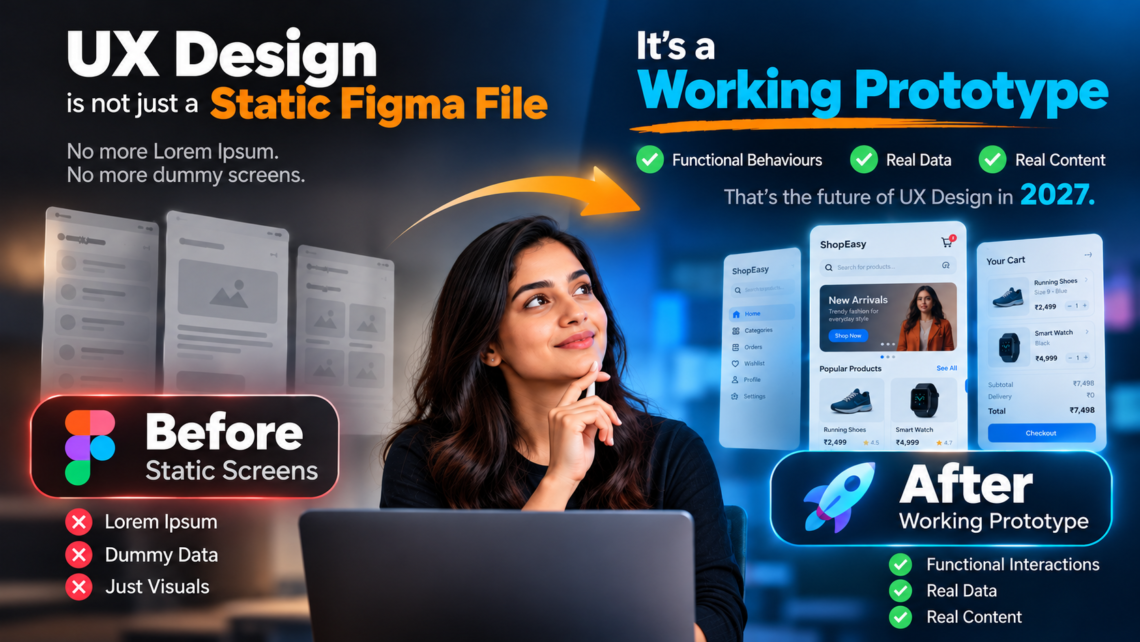
UX Design in 2027: The End of Static Figma Files?
For years, UX designers have been creating beautiful screens, well-structured user flows, interactive wireframes, and polished Figma prototypes.
But something is changing.
The future of UX design is no longer just about designing how a product looks. It is about demonstrating how a product actually works.
Welcome to the next evolution of UX Design.
1. From Static Screens to Working Prototypes
A clickable prototype that moves from one screen to another is no longer enough to demonstrate the complete product experience.
Imagine a banking app prototype where you can actually enter an amount, check your balance, transfer money, and see the updated transaction history.
Or an e-commerce prototype where you can search for products, apply filters, add items to your cart, and see the total price update dynamically.
This is the difference between showing a design and experiencing a product.
2. Functional Behaviour Matters
A button should not just look clickable. It should do something meaningful.
A form should validate inputs. A search field should return relevant results. A filter should change the displayed data. An error message should explain what went wrong. A successful action should provide clear feedback.
UX designers need to think beyond visual states and consider the behaviour behind every interaction.
**The question is no longer just, “Does this screen look good?”
The question is, “Does this experience work as expected?”**
3. No More Lorem Ipsum. Design with Real Content.
Lorem Ipsum has helped designers fill layouts for years. But placeholder content often hides real usability problems.
Real product names, realistic descriptions, meaningful labels, actual pricing structures, genuine error messages, and realistic data can reveal issues that dummy text cannot.
Does the layout still work when a product name is long?
Can users understand the difference between two pricing plans?
What happens when a dashboard contains hundreds of records instead of three sample cards?
Real content leads to more realistic design decisions.
Content is not something we add after design. Content is part of the design.
4. Real Data Changes the Design
A dashboard with five imaginary data points may look perfect in Figma.
But what happens when the data is empty, delayed, inconsistent, or too large to fit the layout?
Designers must consider loading states, empty states, error states, dynamic content, data validation, and changing values.
The future of UX design requires us to understand how interfaces respond to real-world conditions, not just ideal scenarios.
5. AI Is Changing How We Prototype
With AI-assisted design, code generation, and vibe coding, the distance between an idea and a working application is becoming shorter.
Designers can increasingly move from research to interface design, from interface design to functional prototypes, and from prototypes to testable product experiences.
This does not mean every UX designer must become a traditional software engineer.
It means designers have an opportunity to understand more of the product lifecycle and validate their ideas much earlier.
Instead of waiting for development to discover usability problems, we can test realistic experiences before committing to full-scale implementation.
6. UX Designers Must Think Like Product Owners
A screen is only one part of a product.
A product designer must understand the user problem, business objective, user journey, functional requirements, content, data, edge cases, and success metrics.
The goal is not to create more screens.
The goal is to solve the right problem and prove that the solution works.
My Prediction for UX Design in 2027
I believe the UX design workflow will increasingly move towards:
Idea → Research → Design → Functional Prototype → Real Data → Usability Testing → Build → Launch
Static Figma files will continue to have value. They are excellent for exploring visual directions, defining design systems, collaborating, and documenting interfaces.
But static screens alone will become less sufficient for validating complex product experiences.
The real opportunity is to combine design thinking, interaction design, realistic content, AI, and functional prototyping into one continuous process.
A Question for UX Designers
If a stakeholder asks you to demonstrate your product today, would you show them a collection of polished screens or let them experience a working version of your idea?
The future belongs to designers who can do both.
In 2027, UX design will not just be about designing interfaces. It will be about making ideas work.
What do you think? Are we moving from Designing Screens to Designing Working Experiences?
#UXDesign #ProductDesign #Figma #AIinDesign #UXUI #DesignEngineering #VibeCoding