AI isn’t replacing designers. It is changing what designers are expected to do.
For years, UX Designer has been one of the most recognizable titles in the digital design industry. But as AI becomes deeply integrated into product development, the role of the designer is evolving.
The designer of 2026 is no longer limited to creating wireframes, prototypes and polished interfaces. Designers are increasingly expected to understand AI, build prototypes faster, work with code, design AI interactions, and think beyond screens.
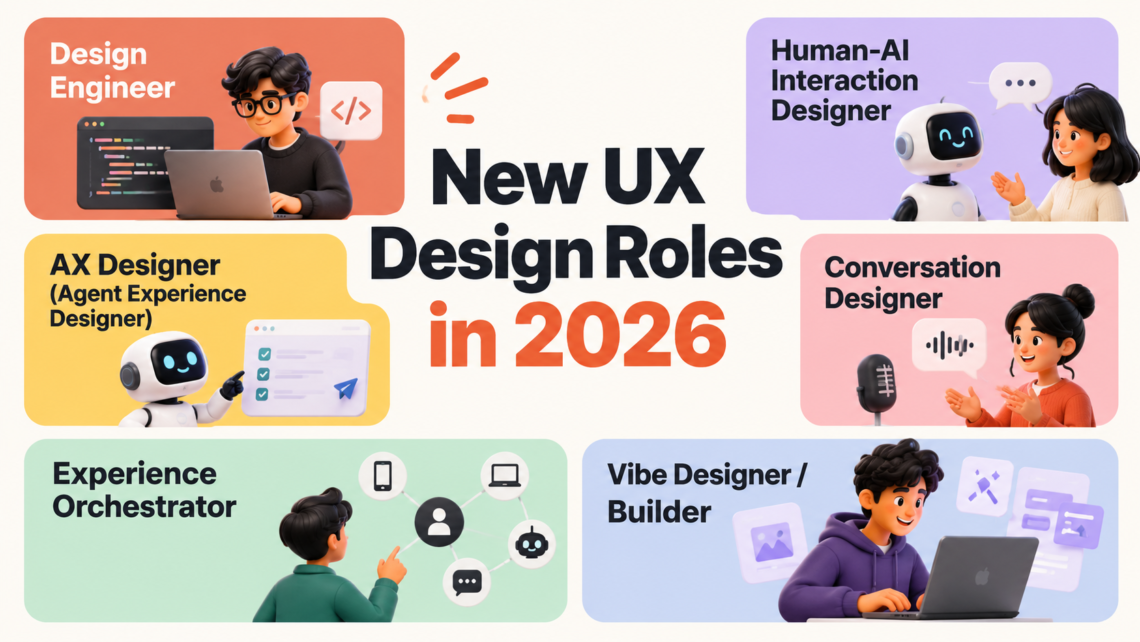
A recent design-role framework highlights this shift and introduces a new vocabulary around emerging roles such as Design Engineer, Human-AI Interaction Designer, AX Designer, Conversation Designer, Experience Orchestrator, and Vibe Designer/Builder.
So, is the traditional UX Designer disappearing?
Not exactly.
It is evolving.
From UX Designer to the Next Generation of Designers
The document describes UX Designer as the traditional umbrella title, while suggesting that designers are increasingly differentiating themselves through specialized skills and responsibilities. 1791189364660
The important change is not simply the job title.
The bigger change is the skill set behind the title.
A designer today may need to ask:
- Can I use AI to accelerate my design process?
- Can I build a functional prototype?
- Can I understand how AI products behave?
- Can I design conversations and voice interactions?
- Can I design experiences for AI agents?
- Can I collaborate with developers more effectively?
- Can I think beyond individual screens and design complete experiences?
This is where the new generation of design roles begins to emerge.
1. Design Engineer
Designing + Building
One of the most interesting emerging roles is the Design Engineer.
A Design Engineer combines design thinking with implementation skills. Instead of stopping at a Figma prototype, the designer can move closer to a working product by using code and AI-powered development tools.
The source describes this role as someone who designs and ships production code using AI tools, highlighting companies such as Anthropic, Vercel and Stripe in relation to the role. 1791189364660
What makes a Design Engineer different?
A traditional workflow might look like:
Research → UX → UI → Prototype → Developer Handoff
The emerging workflow can become:
Research → Design → Prototype → Build → Test → Iterate
The designer becomes much closer to the final product.
This doesn’t mean every UX designer needs to become a full-stack developer.
It means designers increasingly need to understand how their designs can actually be built.
2. Human-AI Interaction Designer
AI products introduce a completely new design challenge:
How should humans interact with intelligent systems?
This is where the Human-AI Interaction Designer comes in.
The role focuses on designing the space between people and AI, including:
- Confidence signals
- Intent previews
- Recovery flows
- AI behaviour
- Trust
- Ethical considerations
- Emotional aspects of AI interactions
The source describes this as the role responsible for the ethical and emotional work of AI products.
This is a major shift in UX thinking.
With traditional software, users generally understand that they are interacting with a predefined system.
With AI, the system can generate responses, make decisions and behave differently depending on context.
Therefore, designers have to think about a new question:
How do we design trust between humans and machines?
3. AX Designer — Agent Experience Designer
Perhaps one of the most interesting new terms is AX — Agent Experience.
Traditionally:
UX = User Experience
But what happens when the “user” is not always a human?
AI agents may increasingly interact with products, services and digital systems on behalf of people.
The source describes the AX Designer as someone who designs experiences for AI agents as well as humans, including semantic structures, action schemas and layouts that are understandable to AI systems.
This introduces an important shift:
UX → Humans
AX → Agents + Humans
Designers may therefore need to think about two audiences:
Human users
and
AI agents acting on behalf of users.
That could fundamentally change how we think about information architecture, interfaces and digital experiences.
4. Conversation Designer
Chatbots, AI assistants and voice interfaces are rapidly changing how people interact with technology.
Instead of clicking through:
Home → Search → Product → Checkout
a user might simply say:
“Find me the best laptop under ₹70,000 and compare the top three options.”
This creates a new design discipline around conversation.
The Conversation Designer focuses on:
- Chat flows
- Voice interfaces
- Prompt engineering
- Dialog states
- Conversational interactions
The source identifies this as an increasingly important role as AI products become more conversational.
For UX designers, this means understanding that a good experience isn’t always a screen.
Sometimes, the interface is a conversation.
5. Experience Orchestrator
Another emerging concept is the Experience Orchestrator.
This role moves beyond designing individual screens or even individual products.
Instead, the designer coordinates experiences across:
Humans + AI Agents + Multiple Channels
The source describes this as a strategic layer involving less focus on pixels and more focus on orchestration.
Imagine a customer journey involving:
- Mobile app
- Website
- Voice assistant
- AI agent
- Customer support
- Physical store
The Experience Orchestrator thinks about the entire ecosystem, rather than designing each touchpoint independently.
This is a significant evolution of UX.
6. Vibe Designer / Builder
The term Vibe Designer / Builder represents another emerging mindset.
The source describes designers who use AI-generated prototypes, move quickly, and communicate requirements precisely enough for an AI agent to build what they describe.
The interesting part is that this isn’t necessarily a formal job title yet.
It is more of a builder mindset.
Instead of spending days creating every screen manually, a designer might:
Describe → Generate → Refine → Test → Iterate
AI becomes part of the design and development workflow.
This is where Vibe Coding and AI-powered prototyping become particularly relevant to designers.
7. Gen UI — Interfaces Created by AI
The future interface may not always be a fixed collection of screens.
The source introduces Gen UI, referring to interfaces that can be composed at runtime by AI.
Think about the difference:
Traditional UI
A designer creates:
Screen A → Screen B → Screen C
Generative UI
The system dynamically creates an interface based on:
User + Context + Intent + Data + AI
This means designers may increasingly need to design systems, rules and behaviours, rather than only static screens.
8. Outcome Design
Perhaps the biggest conceptual change is Outcome Design.
Instead of asking:
“What screen should we design?”
the designer asks:
“What outcome should the user achieve?”
The source defines Outcome Design as designing constraints rather than screens.
This is an important mindset shift.
For example, instead of designing a complicated travel-booking interface, the desired outcome might simply be:
“Help me find and book the best flight within my budget.”
AI can potentially determine how the interface should appear based on the user’s situation.
The designer’s job becomes defining:
- Goals
- Constraints
- Rules
- Context
- Experience principles
- Desired outcomes
UX → AX → MX: A New Design Vocabulary
The document presents an interesting vocabulary shift:
| Term | Meaning |
|---|---|
| UX | Designing for humans |
| AX | Designing for agents + humans |
| MX | Designing for machines to read you |
| Gen UI | Interfaces composed at runtime by AI |
| Outcome Design | Designing constraints, not screens |
This doesn’t mean UX is becoming irrelevant.
Instead, UX is becoming one layer within a much larger design ecosystem.
What Does This Mean for UX Designers?
The biggest takeaway is simple:
Don’t just learn another design tool. Expand your capability.
Knowing Figma is valuable.
But in an AI-powered design environment, designers may need to combine:
UX Research + UI Design + AI + Prototyping + Design Systems + Basic Coding + Product Thinking
And increasingly:
Human-AI Interaction + Conversational Design + Agent Experience + Vibe Building
The designer who only produces static screens may find the industry changing around them.
The designer who can think, design, prototype and build will have a much broader role.
The Future Designer Is a Hybrid Designer
The future isn’t necessarily:
Designer vs Developer
It is increasingly:
Designer + Technology + AI
The boundaries between UX Designer, UI Designer, Product Designer, Developer and AI Builder are becoming less rigid.
A designer can now move from:
Idea → Research → Design → Prototype → Build
with AI assisting throughout the process.
That is why the title Design Engineer is becoming particularly interesting.
Should You Change Your Job Title?
Not necessarily.
Your title is less important than your capabilities.
You don’t need to immediately change your LinkedIn profile from “UX Designer” to “Design Engineer” just because the industry is evolving.
Instead, ask yourself:
What can I do beyond designing screens?
Can you:
- Conduct meaningful UX research?
- Solve product problems?
- Use AI effectively?
- Create functional prototypes?
- Understand basic HTML/CSS/JavaScript?
- Work with AI coding tools?
- Design AI interactions?
- Design conversational experiences?
- Think in systems rather than individual screens?
- Understand both human and machine behaviour?
If the answer is increasingly “yes”, your role is already evolving.
The Real Question: Which Designer Are You Becoming?
The final page of the source makes a simple but powerful point:
“The sorting has begun. Which one are you becoming?”
That may be the most important question for designers in 2026.
The future of UX isn’t about abandoning UX.
It is about expanding what it means to be a designer.
The next generation of designers will not simply design interfaces.
They will design systems, conversations, AI interactions, agent experiences, workflows and outcomes.
And some will go one step further—
they will design it, build it and ship it.
Final Thought
The title “UX Designer” may continue to exist for a long time.
But the definition of the role is changing.
The most valuable designers of the next few years may be those who combine human-centred design thinking with AI fluency, technical understanding and a builder mindset.
So don’t ask:
“Will AI replace UX designers?”
Ask a better question:
“How can I become the kind of designer who knows how to work with AI?”
Because the future may not belong to designers who compete with AI.
It may belong to designers who know how to design, direct and build with it.